
Attention: U.S. Department of Education
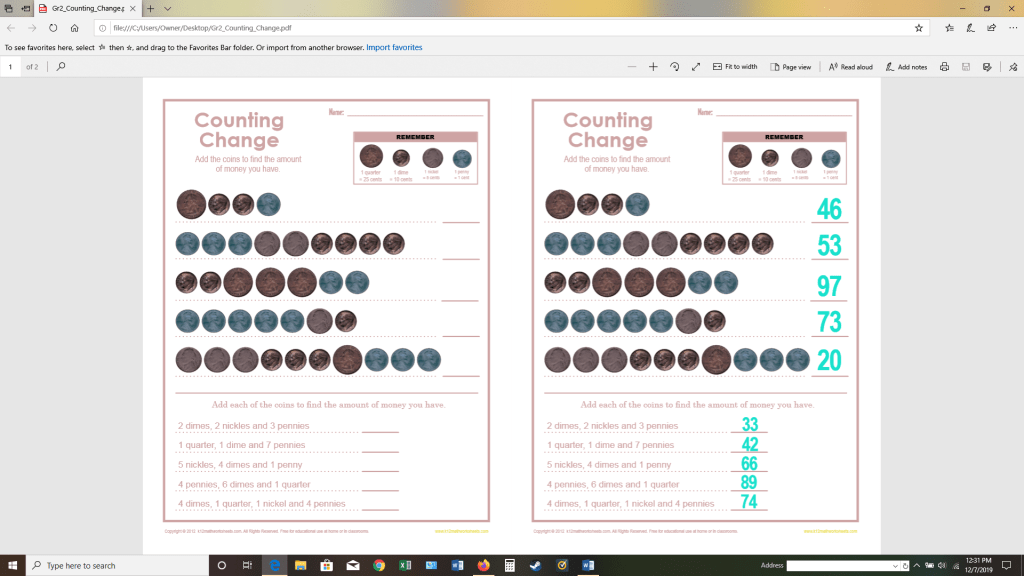
I just bought an Apple Fritter at Dunkin’ Donuts. It cost $1.81. I handed the young lady two one-dollar bills. I got back 23₵. Now, this, of course, is indefensible. But let’s try to defend it anyway:
“Your Honor, my client was never there.”
Judge: We have her on camera attending to Mr. Perrin; store records and co-workers also attest to her presence.
“Your Honor, my client never gave anyone change that day.”
Judge: Again, we have her on camera. And it is clear in the enhanced video that she handed him two dimes and three pennies.
“Your Honor, my client can’t be expected to do that kind of math because she is too little to know that yet. “
Judge: She must be 16 years old to work at Dunkin’ Donuts. Records show her as a High School graduate and that she is 24 years old. She appears to be of normal adult size for a female in our society.
“Your Honor, my client was victimized by the cash register not telling her the correct change to dispense.”
Judge: this court does not recognize outsourcing one’s own responsibility to engage a couple of brain cells once in a while. And the cash register has been shown to be working perfectly, before and after.
“Your Honor, my client simply mistook one of the dimes for a nickel- it was a simple mistake to make.”
Judge: Not so fast. First, that would still render the change short by one cent. And, while nickels make great quarter impersonators*, they cannot reasonably be understood to be mistaken for a dime. It doesn’t happen.
“Your Honor, my client overpaid the Plaintiff, and did not in fact short him; it is therefore clear that Plaintiff has no cause of action.”
Judge: Are you asserting that your client conspired with Plaintiff to engage in the larceny of four cents from Dunkin’ Donuts, one of the largest coffee and baked goods chains in the world? Or that this cause of action should have been brought by Dunkin Donuts?
“No, Your Honor. My client is not guilty by reason of insanity.”
And so forth . . .
I am forced to conclude, and I am sorry for it, that the young lady had a different perception of what was supposed to happen during the transaction than I did. She must have thought of it in terms of three simple clear steps: 1.) I give her money. 2.) She gives me a thing. 3.) She then gives me back money.
And that’s it. Next.
*https://www.youtube.com/watch?v=G0NsYlofNSQ
#dumbasrockskidslazyentitledhelicopterparentedsnowflakes
 Penultimate
You must be logged in to post a comment.