
(there are no straight lines in nature)
Family legend has it that I once touched a hot stove and then said ‘ouch’, but, other than that incident, there aren’t a whole lot of straight lines that have been discovered within my thought processes. A team of explorers went in with pith helmets and machetes and haven’t been seen since. I guess they got lost in thought.
A Ha-ha-ha.
So, today we’ll start at Stop & Shop and end up at the biggest mystery of the universe.
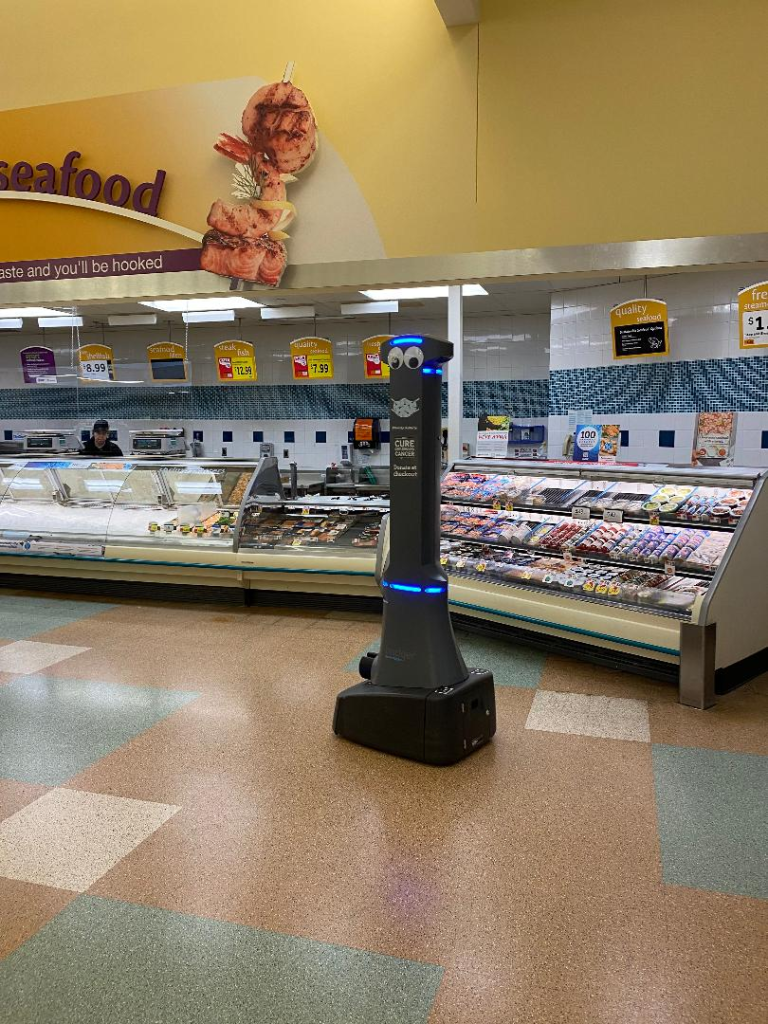
I’m at Stop & Shop supermarket Sunday and turned around and almost jumped straight out of my boots when confronted by their big floor cleaning robot. Have you seen these guys? Tall, grey, monolithic, they move slowly down the aisles cleaning the floor underneath and of course they must have some great sensor system to keep it out of trouble. But man, that f’ing thing scared the bejesus out of me. It is about 6 feet high, a littler wider at the bottom where it cleans the floor but is overall vaguely of human form.
It is vaguely of human form, sure, but alien, and lifeless. Maybe that lifelessness is the spooky part, the part that provokes that visceral jump. And that feeling is not just fear, fear of the unknown or the unexpected, but it is a fear mixed also with repulsion. And the repulsion hangs in the soul long after the fear subsides with a “Ha, it’s just one of those cleaning things!”
And, before robots, we had other lifeless representations of the human form to feel creeped out about. I remember museums as a child, and scenes of tableaux about historic events and such where they had figures staged; I got the same feeling of wariness and repulsion even though the figure representations were always poorly done. Most looked as if a 4th grade class had enthusiastically embraced a big papier-mache’ challenge.
And in between robots and old bogus museums, we saw the widespread emergence of store mannequins modeling clothing throughout big clean department stores. This one is fascinating. (If you saw the Twilight Zone episode where the store mannequins come alive at night, you get double extra credit.) Store mannequins, though more lifelike than anything outside of Madame Tussaud’s Wax Museum, still rock the creep factor. For mannequins, this is an unexpected directional pull; the more lifelike but still not living these mannequins get, the more disturbing they become. And there will always be associated with them the special horror wherein a hiker or jogger will find a dead body and inevitably tell the police “I thought it was a mannequin at first.” There is such an inherent and weird dislike, and in some ways, an elevated dislike.
OK. Visceral. Inherent. I guess I should say that we are programmed from primitive times to fear lifelessness, and especially human form lifelessness. And lifelessness equates to death, the lack of life. So, all of these representations of the human form without life must remind us of death, or at least some kind of evil or zombie-like death thing. And we fear that. We abhor lifelessness.
Why do we fear death? What happens after death? (We’re at the biggest mystery of the universe part now.)
Well, the fact that the repulsion is not affirmatively learned, and is instead automatic, makes me think that maybe somewhere down deep we all know that when we die it really is indeed game over. Dirt. Worms. The long dark empty nothing of your own endless forgottenness. You are soon completely forgotten as the living world moves on. This must be the worst thing that a sentient human creature can imagine, and so even general representations of our death carry an instinctive dread.
Now, can this response coexist with a belief in some kind of utopian afterlife? Well, it does. I’m not saying it should, but I’m saying it does. There are tons of people who believe in an amazing afterlife through some God-centric belief structures and yet they still react to lifeless representations of the human form the same way I do. I’ll bet the Stop & Shop cleaning machine has claimed many a God-fearing shopper as a fright victim. Can these two things be reconciled: the gut-reaction, with the afterlife belief? I feel like I have to pick a side: I’m at a roulette wheel with one chip and I have to place it on the red or the black.
It may be that we were programmed as primitive beings to harbor a dread of death, and what I’ll call ‘the afterdeath’, and, as time evolved, we invented religion as a way to try to de-program the built-in fears of the afterdeath. By replacing those fears with an afterlife belief system, religions have an answer, and that answer is quite palatable though entry into the various clubs depends upon strange rules. But religion is an answer, and an answer is often better than no answer.
Though, if you’re still with me, this makes me realize that, ironically, the religious are the deprogrammers and not themselves the ones in need of deprogramming―unless one wishes to lead them back to nothingness.
Well, pick a side.
Me? I’ll trust my gut.
 Penultimate