Fly Shot

Take a careful look at this picture.
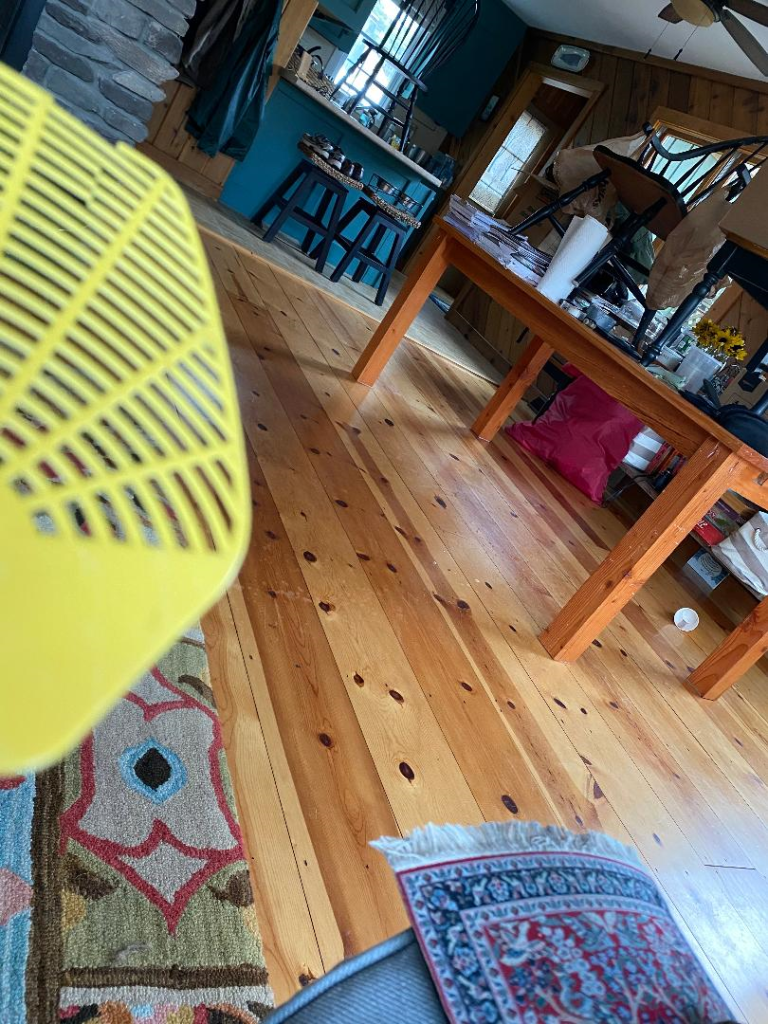
This morning, I’m sitting at my computer in front of a beautiful crackling fireplace which is just out of sight; the right stone wall of the fireplace is visible above the yellow fly-swatter. On the little table in front of me, also just out of sight, is my laptop, my coffee, my wallet and the TV remote. Lying near my right hip on this big couch is the trusty yellow fly-swatter which I had used yesterday in a brief, but quite successful, campaign against a small squadron of flies. (I had left a window open and it was a really warm October day. Whoops.) I’d forgotten about the fly-swatter so far this morning, though, because I pretty much ‘got ’em all’ yesterday afternoon and hadn’t seen any since.

A big fly suddenly jinked his way into my vision and landed in plain site on the left side of my coffee cup. I had a jolt of many thoughts at once—you know how they say things slow down during moments of great crisis like this. My coffee mocha! I had lovingly made SwissMiss Cocoa and mixed it with coffee and added just the right amount of Half & Half to make a hot deluxe mocha. Yummers!

But then there were all these other thoughts. . . “But what are the odds the fly-swatter would be resting by my right hand at this moment!? And it’s a brutally clear shot—the key will be immediacy— yesterday’s flies were jumpy and quick—and also there won’t be any need for stalking. He is already easily within the maximum effective range of my weapon by happenstance of his landing so close. I won’t even have to get up.” Remember, all of this in a split second. “And this might be the last outlier from yesterday’s heroic battles— the last Japanese out of the caves in the Philippines. Maybe we can all have closure if I kill him.” Alright. I’m pushing it here.

There must have been some quick algorithm that played out in my head but all I remember is the violence of the rocket shot that nailed the cup of coffee and sent it straight away like a line drive. I sat there and looked about me, in shock, the way someone staggers about the highway after crawling out of a car wreck.

To my delight, there was the dead fly—see in the picture just to the left of the foremost table leg and up a bit; you can see it on the floor between the darker brown knotholes in the planks and actually also within a small constellation of reflection spots in the camera shot. These may be reflections of light off of some of the big coffee drops on the floor? Anyway, there he is for sure if you zoom in—the enemy slain on the field of battle, tilted on his side like a little ship grounded softly ashore a beach. Sad it is. I am also aware, however, of the nobility of the fly in the photo, as it sallied forth for his people in a desperate bid for supremacy, and a possible sip of coffee. He has his place in history.

I ponder Emily Dickenson’s Success Is Counted Sweetest: . . . Not one of all the purple host / Who took the flag today / Can tell the definition / So clear of victory / As he defeated dying / On whose forbidden ear / The distant strains of triumph / Burst, agonized and clear! /

Defeat is a heavy burden to bear, my poor friend, but, because of that, so is Victory.

Speaking of coffee reflections, you can see the coffee/mocha spatter in a wide path directly away from me, through the dead-fly-zone, and to the coffee cup resting on the floor at the far end of the shot. Alas, my delicious mocha! You can see what’s left of it laying in the coffee cup like dirty water resting in a culvert pipe.

So. I took a quick picture and cleaned up the floor and wrote this down.

“Nice shot Kevin. But that’s not what adults do.”

I know.

Sorry.
Dear Dunkin Donuts

I’m writing today to express concern about my discovery this morning that you have changed the way you make Apple Fritters.

Upon the merits, this managerial decision does not survive scrutiny. What we had before was an exquisite bumpy landscape of crispy donut and glaze heaven that erupted in delightful surprises of apple filling. What we have now is an ordinary donut dressed up sadly in dime-store Apple Fritter clothing. Before, every fritter was a different experience as one nibbled down from various angles in hunt of crunchy goodness parts and nipped at the soft underbelly spots of apple filling. Now, it matters not where one begins and ends. The new version is a lazy Halloween costume of an Apple Fritter but, ah, the old version is Alice In Wonderland, lovingly handsewn by Mom- and it charms the neighborhood.

What’s next? We have a demagogue for President, the disrespect of the world, domestic racial and judicial strife, political division bordering on Civil War, a Pandemic wildfire that is killing tens of thousands of our loved ones and wrecking the dreams of hard-working business owners and now you want to dumb down the Apple Fritter?

For shame, Dunkin Donuts. Please restore the original Apple Fritter, and, I daresay, the hope that some of the best part of America will survive these dark times.

Born This Way

It seems that people go to war in a manner almost entirely dictated by the accident of the timing and geography of their birth. If I were a young Afghan man in 1979, the odds that I would end up fighting against the Soviet invasion would be near total if I were in all other ways normally fit for Afghan military service. Conversely, were I a young Soviet man in 1979, I would have fought against the Afghans. Exceptions to this rule certainly exist, and they are interesting as hell, but they are not statistically significant.

Think of the young man coming into manhood in Germany in the late 1930’s. This incredibly unfortunate circumstance would have placed him in the German Army during World War II. And he would have been marching in a German uniform almost no matter who he was prior to 1939–and that’s the scary part. The fact that he was there, then, was dispositive. It almost never matters significantly to the building of an Army that any given Soldier was a nice guy, or a bad guy, a hawk, or a dove. The forces of culture, peer pressure, and generally innate local loyalty ensured that Napoleon, Hitler, and Westmoreland had all the Soldiers they needed to conduct war on a massive scale.

There is not much evidence that this will change; as recently as today Americans went to Afghanistan and/or Iraq because of where and when they were born. The guy who grows up on a farm in Iowa doesn’t decide that there is an African Civil War he’d feel better about being involved in versus America’s engagements unless he’s a mercenary. Mercenaries are few and far between. Instead, Austin Farmboy goes and fights on America’s behalf in Afghanistan because he graduated High School in some nice little town in Iowa in 2018.

Let’s first distinguish between whether someone goes to war at all versus whose team they end up on. Lots of people don’t go to war at all for various reasons: unfit medically or mentally, too old or too young, ineligible due to gender, or just never conscripted and therefore preferred to do, and did, other things with their lives. Of course, faced with conscription, some get out of going to war due to corrupt reasons: with the help of connections, or fraud, or financial status. But these evasion of service cases added up don’t materially affect any war. (Someone is sent in their place, someone else whose accident of birth is appropriate for the war.)

Focusing now on those who do go to war, let’s picture how it typically goes down. Let’s take an Australian guy in World War I. In Australia, 38.7 % of the male population aged 18-44 enlisted for service in support of the British Empire and against the Germans. Why? Because their uncle at the dinner table was blustering triumphantly that the Germans would finally get what they deserved. Because Grandpa fought with the British in the Boer War at the turn of the century and was wounded! (There’s his service rifle still over the fireplace right there; he let me hold it once.) Because all the young men have been walking about town looking importantly at each other and discussing which Regiment to join. Because, especially because, his Ma and little sister are terrified; and that makes you know that you are suddenly important. Because Regiments and uniforms and guns and ‘doing your part’ suddenly crystallize colorfully in the air over the drab landscape of crops being harvested and sent on coal-fired ships elsewhere. Because Australia pledged support to the British Empire and By God, the Australians won’t let them down. Because Governor-General Thomas Denman, (3rd Baron Denman Ronald Munro Ferguson), is making an important radio announcement tonight and everyone in town will be gathered in groups listening.

That’s why they went to war, and not because of any protracted thoughtful analysis of the morals, ethics and values involved. They simply went with the home team and reaped the respect of their peers and communities.

Substitute the time and place and we’ve seen this drama play out similarly for centuries. So, why point out this embarrassing fact? Because it’s time to talk about the Confederate Army in the American Civil War. Alabama, April, 1862.* Fort Sumter has just fallen. Jedediah Farmboy from Alabama is going to wear a Confederate uniform for all the aforementioned reasons: His uncle, his grandfather, what Regiment should I join, Ma is worried but I’ll make her proud. Sure- arguments over slavery, state’s rights, economics, and all manner of indignation over politics got discussed at the General Stores, North and South, but these issues and discussions didn’t materially affect the makeup of the Regiments. A Georgian Regiment was made up of Georgia boys and a Maine Regiment was comprised of Maine boys.

So, if we accept all this, how can we tear down statues of Confederate Generals, and the states they represented, when we know that they did what they did by accident of birth and then generally tried to carry out their mission with all the honor and bravery they could muster? Especially when we know that Joshua Chamberlain himself would have fought for the Confederacy were he born in Mississippi instead of Maine? People usually give two reasons: “Well, the Confederates were all traitors.” But, our founding fathers were traitors to their country and we can’t get enough statues of them. “Well, the Confederates lost.” But, we lost in Vietnam (and elsewhere) and we haven’t torn down our memorials to the Vietnam War in every town.

Sure, slavery was so bad that we shouldn’t endorse it in any form. But, how far down that chain do we go? Do we abolish every knicknack, song, or favorite southern food that is reminiscent of the Confederacy? Trust me, the Civil War is barely over and insulting the history, honor and sacrifice of hundreds of thousands of people who had to go to war by accident of birth will probably backfire, and soon.

People who revere the statues and flags of the Confederacy due to their own racial bigotry against blacks won’t convert because some of their favorite symbols are attacked. To the contrary.

And people who revere the statues and flags of the Confederacy due to southern military honor and family history will feel the caprice and hypocrisy of the moment and won’t forget it.

Too

I wish, for the life of me (pun intended) that the original signs and placards of the current movement had said “Black Lives Matter Too” and that the movement was called Black Lives Matter Too. The amount of stumbling around on the meaning of this short phrase has caused a lot of unnecessary angst; the worst of this is that so many people are accused of racism when they are simply the victim of an expectation to make a secondary level of analysis that they are readily capable of making were they aware of the expectation.

For example, let’s say that I wanted to start a movement and I called it “Alcoholics Like Ice-Cream.” Most people would find the phrase lacking in power or gravity because they would immediately realize that all people like ice-cream: children, Eskimos, college students, criminals, and mountain climbers. Many wouldn’t as quickly realize that the phrase attaches to a special struggle wherein many alcoholics in early sobriety efforts become addicted to sweets as a kind of ‘replacement’ addiction. They might even think that alcoholics might be just trying to carve out a special status for themselves by saying that they like ice-cream more than others, and are therefore more special. This morning, in my AA meeting, someone mentioned how they had a candy bar the other day and immediately found themselves thinking ‘Where is my next candy bar coming from?’ This remark caught us all just the right way and we all laughed longer and deeper than most people would because we identify so strongly -more than most- with addiction dynamics because we are alcoholics.

Similarly, I’m guessing most blacks didn’t stumble over the meaning of the phrase ‘Black Lives Matter.’ But many of us, my white self included, did stumble, and just didn’t get it until someone said to us, or it eventually occurred to us, that what the signs mean is that black lives matter too, and that American society and justice mechanisms currently discount the lives of blacks compared to whites. Then the light came on, and of course I recognized the issue quite as much as any sentient being would be expected to and I now get that it is a great slogan for this movement-just a little unclear at first grammatically. Not unclear racially. It wasn’t racism that made me think ‘Wait…all lives matter’, it was grammar construction.

I would like to have have been enlightened enough to have ‘gotten’ it initially, and there is a special reason why I should have: I am a poet, and have long known that poems carry special power, and that the first layer of power in a poem, before you get to the interpretation of the words, is the simple fact that the words and thoughts in a poem are framed and presented in poetic format and therefore purport to carry poetic power. Thereafter, the poem may succeed or fail upon its merit, but the initial expectation is that there is going to be something special here that might want to be analyzed beyond face value. I approach, and indeed write, every poem with the expectation of a second level of analysis, and that a set of words arranged in a poem merit that. Therefore, since these three words -Black Lives Matter- were specifically ‘framed’, perhaps I should have asked myself why the emphasis is on black lives in the movement’s slogan when in fact it is obvious that all lives matter. Alas, I did not, and just knee-jerked to wonder how the movement’s organizers didn’t see that all lives matter. The super irony here is that the organizers not only saw that all lives matter, but that it is because all lives matter that attention must be drawn to the issue of black lives because they arguably don’t seem to matter as much as other lives in America as judged by police behavior, incarceration dynamics, and racism in its myriad forms in our culture.

I would like to rebut here the assumption that I’m blaming the victim by saying that there is a problem with the wording when I should be addressing racism itself. I also recognize that many people might be saying ‘All Lives Matter’ in a racist way, or that white privilege might be driving some of the indignation against the slogan. Interestingly, I can usually tell by the demeanor of the person the intent of their objection. But, in my experience, I think most people that said initially, or still say, ‘all lives matter,’ do so over this misunderstanding that I am so painfully exploring in this piece. And that is good news. I wish merely to illustrate an exacerbation that need not be added to an already difficult situation.

And there is more good news. Whether the grain of sand in the oyster is intentional or not, it does produce a pearl: the slogan is an irritant that caused me to have some long conversations about racism in America and I hope that such conversations continue everywhere. It matters.

Marble Drop

A man is lying on his back on a surfboard far out on a dead calm sea. He is a bug on a glass mirror. He is tired, and looking vacantly at the sky. His arms are by his side and he grasps the edges of the board on either side near his waist; his balance is precarious enough that the merest wave will begin to tip him.

He is thinking. There is an ocean above him and an ocean below. He arrived here as through a carnival Marble Drop game; every time he hit a pin in life he could have gone left or right on the way down.

He hears again the marble hitting the pins and closes his eyes to mute it but the sound only gets louder. He wants it to stop and slides his hips slowly to one side. The board rocks to a tilt along its long axis. He turns his head, opens his eyes, looks at the water and sees himself looking back. He has seen enough. He tilts further, and slides into the water.

The cool water shocks him into tension and it is with effort that he exhales fully, makes himself limp and descends. He sinks. He rolls slowly as he falls and gets a last look up at the diamonds on the surface of the water in the sun. He turns again to the dark and the deep.

He inhales, and there is a great stab to his lungs and a peculiar desperation makes him bicycle and flail his arms for a moment. He screams one loud long burning scream and then it is over. He sinks further and the quiet embraces him, the dark embraces him, and the cold begins to take away the pain.

Now he feels the pressure of the water and it pushes upon him a feeling of safety like an infant swaddled in a blanket. He feels sleepy, heavy and warm in the arms of the dark; a calm overtakes him as he spirals slowly down and down and down.

In the black calm, his vision becomes spotty, and he begins to see things. Tiny creatures of phosphorescence begin to streak by him like stars and comets as he accelerates. He falls into the relaxed bellow-down freefall position of professional skydivers. As he reaches terminal velocity, he experiments with languidly dropping an elbow, bending his knees or straightening his legs. He is delighted at the turns, spins and movement he can control and learns that by bending his knees up he can even go backwards. He continues to spin, tumble and play as he falls through the thick black night, utterly content.

After a short while he notices far beneath him a lightening in the water. He has come to love the dark and is curious how this light could be. He stabilizes his position to watch it grow more and more light as he falls. The vague sense of light develops into a whole sky of light beneath him at this other end of the black. Finally, to his surprise, he punches through the bottom and drops out onto the surface of the ocean, furious and foamy, with the light of the sky above him once again.

He instinctively gasps and pulls in oxygen as fast as he can while he struggles to tread water in the white foam and he is lashed by the power, howling, and weight of the wind and the waves and the light of the sun; all his senses are attacked and in the confusion he is drowning. But the air has given him strength and he composes himself, slows his movements, and begins to float with less effort. The storm abates, and he waits.

After a while, a large boat picks him up, and he is on deck, being given water, food, and a blanket by the crew. He suddenly sees his surfboard on the deck and gives a cry of recognition.

The crew notices and one says “We found it a ways back in the water. Is it yours?”

“Yes.”

“Do you want it back?”

The Truth About Being Wrong

I think we can all agree that people ought “not be judged by the color of their skin but by the content of their character.” (If you don’t agree with this famous premise, you may stop reading now and you might want to go back to an earlier century where you’ll be more comfortable.) We’ll get back to the word ‘all’ shortly.

Given this premise, the presence of racism in the United States is vexatious–to say the least.

I was listening this morning to two prominent black Conservatives/Republicans on a radio talk show bemoan that so many blacks mistrust Republicans more and more even though less than 30% of blacks characterize themselves as ‘liberal’ while moderates and conservatives make up over 50% of the black population. The subtext of the conversation seemed to question why the Republican Party is viewed as being on the wrong side of so many issues that affect blacks/minorities and that they care deeply about. Further, they seemed to try to explain the behavior of the Republican Party as misunderstood, or even that the Republican Party has lost the ability to differentiate between right and wrong–due to a complicated political situation.

I think they’re missing the boat. Racism comes from a few different sources, and none of them is about being politically confused. People learn about others by drawing upon direct experience, or interpreting data, or are taught at home about other people (other races of people). All three of these input streams are reliably problematic, and, for some people, problematically reliable, indices of character.

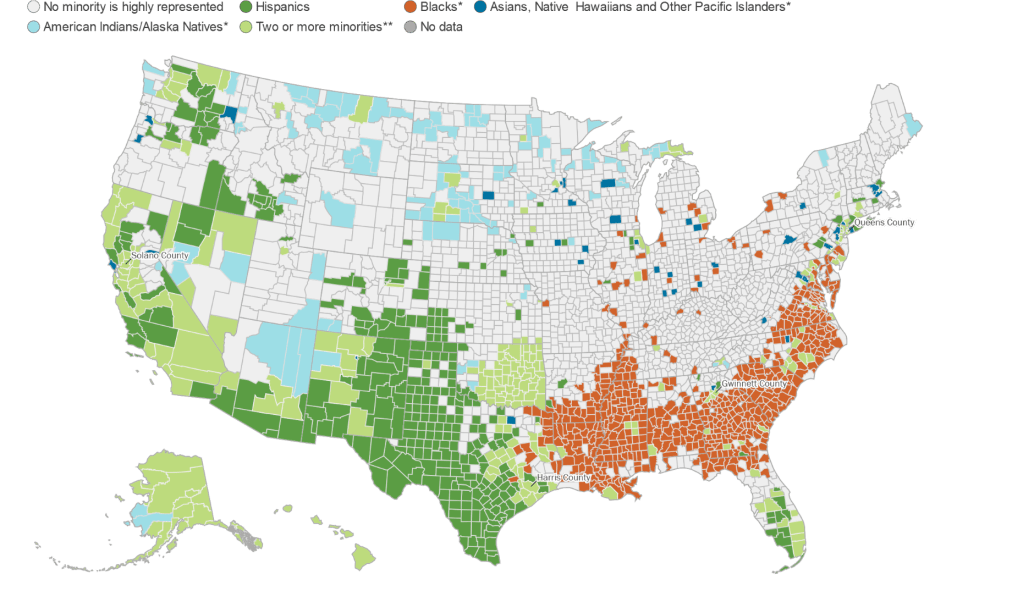
Direct experience would be reliable, if only one could meet a class of people as a whole instead of in necessarily unrepresentative samples, and if one could use direct experience in lieu of data and other ‘teachings’ and not in addition to such indirect experience. However, look at this map of the US in 2010 which color-codes minorities in counties that have minority representation above the national average and are therefore ‘highly represented’:

If someone is not living in the Southeast (orange) or in a relatively few Northern urban centers, then it is difficult for most of the country to get significant direct experience of blacks since most people are living where blacks are not ‘highly represented’, or represented at all. Accordingly, most of us only get the occasional experience of interaction. (Incidentally, I spent most of my adult life in the military where minorities are ‘highly represented’, and in my experience all manner of decent character and also human quirks and foibles are represented roughly the same proportionally among all peoples. I found this experience encouraging and, though I realize I was only exposed to a population that self-selected for military service, the experience felt genuinely representative.) Even living in the Southeast outright, where presumably direct experience would be a much more reliable indicator of character due to sheer volume and variety of direct experience, is problematic in that now you are living within an area stained by generations of slavery, prejudice and the institutionalized view that non-whites are inferior. So, direct experience is not the panacea for enlightenment that it ought to be-but it is still the best path to understanding if filtered for historical context.

Data seems to be the largest information stream that many people cite to support their prejudices. Two examples: Look how many are in prison! Look how many are on welfare and have children out of wedlock! But I would argue that the statistics cited are often chosen with a confirmation bias. For example, who cites the fact that the crack epidemic was met with a war on drugs-resulting in mass incarceration-while the (largely white) opioid epidemic is being met with prevention and rehabilitation efforts? For the former, a prison sentence places felons returning to society at a great disadvantage while, for the latter, a trip to ‘rehab’ is becoming de rigueur. And this is before factoring in the socioeconomic factors that might drive certain populations more to despair and consequent drug use than others. As for children out of wedlock, how many people factor in the acceptance of contraception and abortion in society? By making the birth of the child the physical choice of the mother, the sexual revolution has made marriage and child support a social choice of the father. Shotgun weddings are gone, and women who want children can no longer count on pressuring the biological father into marriage under these circumstances; concurrently, the stigma of unwed motherhood has declined. And, welfare is not as related to out of wedlock births as people might choose to believe: welfare benefits could not have played a major role in the rise of out-of-wedlock births because benefits rose sharply in the 1960s and then fell in the 1970s and 1980s, when out-of-wedlock births rose most.

Finally, the weakest argument I have ever heard trotted out to support any position is “That’s how I was raised.” (Amazingly, it is often also used to support one’s religious orientation-another incredibly consequential choice!) Unfortunately, many people are raised in households of prejudice, and don’t question it very much; it is as if supporting the beliefs of your parents is honorable, despite the dishonor of their beliefs. I always respond to hearing this with “Why don’t you do some independent analysis of all religions (or other home-taught beliefs, such as the disparaging of another race) and see if you arrive at the same conclusion?”

It seems like the thread running through all of these ways to arrive at opinion is the overt choice as to whether or not to indulge the instinctive pull toward cherry-picking beliefs that support one’s inclinations- whether those inclinations be beautiful or ugly. Why are we inclined to prejudice? Maybe it is as simple as fear of the different, or the primitive human impulse to feel superior to another.

Or, put another way, maybe it is because we won’t ‘all’ agree that people ought “not be judged by the color of their skin but by the content of their character.” Many of us choose not to endorse the premise. For them, the color of the skin is enough to judge character.

And so, if you find yourself in a pickup truck with shotguns chasing a black man down the street while he is jogging, your analysis might be lacking. And that is wrong. Truthfully.

Take This With You

(The devolution of don’t-leave-home-without-it.)

The earliest people probably never left the cave without a weapon. A club, a spear, etc. -this was the first essential. There were enemies out there, and some of them were your neighbors! Next came some form of carrying one’s valuables. The oldest wallet was found on Otzi the Iceman who lived in 3300BC; this leather wallet contained flints, and some tinder, but no money! (How would you like to have been living in the Copper Age, and also been broke?) So, as society evolved and the weapon requirement dropped off, everyone still had some kind of wallet, or purse essential to grab before leaving the house. Millennia ensued. Then came keys. OK: wallet and keys, -check. Then came the cell phone. My god, the cell phone. OK: wallet, keys, phone -check, double-check, let’s go. Then came the pandemic and the requirement for face-coverings/masks. OK: wallet, keys, phone, mask -let’s go. Then came the armed protests against this mask requirement and the divide over how much inconvenience one should endure for the safety of another. Whoops! Time to bring the weapon back. OK, -going somewhere? Wallet, keys, phone, mask, and gun. There are enemies out there and some of them are your neighbors.