
When I was in Afghanistan, we didn’t have many deaths in my region, thank God, but when we did, it was a very, very big deal. The process for dealing with it is so complex that myriad spreadsheets, templates and documents govern it and the whole thing is extremely professional and respectful. I believe it would hearten the families slightly to know what goes on before their loved one even gets on the plane to be transported home. For example, there is always a Memorial Service for the Soldier in the theater of operations first, and there are sixty-seven steps between the initial gathering of the fallen’s personal effects to the start of that Memorial Service. I have the spreadsheets in front of me now. Tons of people are involved from the Commanders, Staff, and Chaplains down to the Soldier’s bunkmates.
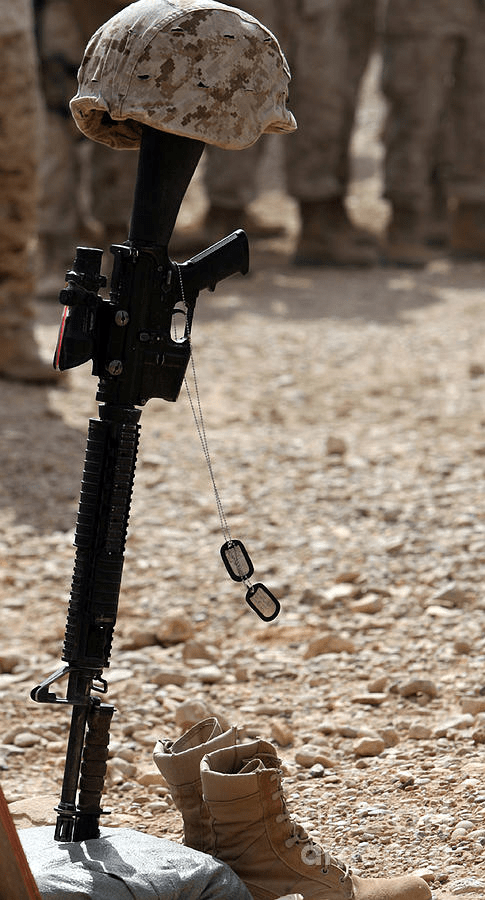
I remember one such Memorial Service. The obvious place for this to happen was in a big hangar-like structure where lots of people could assemble out of the weather, sandstorms, etc. and chairs could be set up with precision. A microphone could be hooked up. Also, there was a platform where the fallen Soldier’s boots, helmet and rifle could be displayed nicely for the ceremony. The question arose early as to the choice of location and as the Operations Officer I was the lead in twenty-two of these steps, and ‘location’ was one of my twenty-two. (Chaplains and other Staff members were the leads on the rest.) I chose the hangar and, surprisingly, for the first time, I got pushback; some people wanted this to happen outside ‘at the flagpole’ in the middle of the compound. I guess that’s what the Soldier’s friends wanted.
The flagpole area was small and had lots of logistical disadvantages, not the least of which was that there were huge generators that ran power for the whole base adjacent to the small clearing for the flagpole; those generators would have to be shut down for anybody to hear anything. I wasn’t used to being challenged on anything as the Operations Officer for a couple of good reasons: I worked my ass off day and night addressing everyone’s concerns and I really was friends with pretty much everybody–I was stunned that I got put in the Operations Officer position and took it as seriously as anybody could. In that position, I knew instinctively and right away that my superpower was not always so much that I could do good as that I could stop so much stupid. So, I was stopping stupid all day long: I revamped many systems and I guess I had a great reputation, and the Regional Commander always backed me up in the rare case of a point of contention among the Staff or Soldiers. And the Regional Commander was the only guy in our nine Provinces who could overrule me. Please note, however, that decision-making is often more nuanced than merely relying upon whether one actually has the authority to make a decision; good leaders at all levels listen closely to their experienced Sergeants and peers and I certainly always did. Of course, Commanders have the ultimate decision-making authority, period.
So, during this blizzard of planning, I wanted to stop the stupid of holding the ceremony at the flagpole. (By the way, the fact that so much stupid happens in a war zone is mostly the function of millions of moving parts, and not any indication of great incompetence. The people were by and large professional, courageous and smart–it’s just that you always need people at the top who can see the big picture, synchronize, and ‘stop stupid’–that’s what we called it back then!) Anyways, contractors across the base were already approaching me about the rumors of the power being cut off to hold the ceremony and were asking about simply holding the ceremony in the hangar. “Jesus, what about refrigeration? Heating and air conditioning? Power tools for all the building that was always going on?”
Yet, interestingly, a fellow Major in my own Operations Center was leading the ‘flagpole’ faction. Bill was a really good guy, very smart and professional, and, by dint of seniority, arguably should have been picked to be the Operations Officer instead of me. But, despite this disappointment, he took it well and we remained friends and worked very closely and supportively together every day, all day, under a crazy stressful workload. We were fellow Musketeers in ‘stopping stupid’ and would have many a wry laugh about it together, day and night. I saw him many years later at a conference and our bond was still there.
Well, Bill got the ear of the Commander and I was quietly overruled. Wow. OK. I certainly didn’t have anything against Bill for all this; it was just one thing. I scrambled to address all the concerns about my parts in the normal planning and now also the family of emergent concerns dealing with the generators all going offline for a few hours. I had so many other balls in the air that there was no time for me to sulk over this little planning defeat for this one funeral.
The ceremony comes, the generators were shut down, and everybody could hear everything in the little space. The flag was snapping lightly in the wind and at the base of the flagpole was the standard but always striking display of the fallen Soldier’s boots, rifle, dog tags, and helmet.
It was a long ceremony: Prelude, Posting of the Colors, National Anthem, and then the ceremony actually begins all the way through the volley firing and the playing of Taps. In the middle there somewhere, the deceased Soldier’s Squad Leader got up to speak.
They had really been friends, and it came through his words immediately. This wasn’t just a Squad Leader/Squad Member relationship. These guys were in the same gun-truck and patrolled every day together and, indeed, he’d been right there when his friend was killed. He now said he was grateful that we’d allowed the ceremony at the flagpole as they were all very patriotic and he knew it was what his friend would have wanted.
Uh-oh.
I’m standing right in the front line of Soldiers and I’m looking right at this guy.
They were on so many patrols together, sharing the constant threat of enemy fire and, more probably, an explosive device in the road that would shatter their truck and their worlds–as did happen. I knew from being on patrol that within any given gun-truck, Soldiers talk on the ‘mic’ among each other all day every day and by the end of a few days, all the guys in a particular vehicle are brothers; they know who likes what kind of music, where they’re from, and, especially, who is the funniest sonofabitch with the insults that fly back and forth. All this while scanning and reporting threats, navigating, and coordinating their movements within a larger convoy of vehicles on a mission.
The Squad Leader continues to talk about his friend, and he suddenly starts crying.
Fuck. Jesus.
Everyone is looking down now politely. Especially me.
He gets himself together and continues: They were also bunkmates, and shared the same little plywood hut partition together and would play Call of Duty together whenever they were in the hut for the night. (I know this video game and it was, and still is, very popular with the Soldiers and probably plays some therapeutic stress-relief function.) At some point, he made some small joke about their playing Call of Duty together and our gathering shared a much needed laugh about it. Although I remember the sudden wave of polite laughter, I didn’t reallyyy hear the actual comment—and I don’t think I heard anything after he started crying.
A slow burn of shame had crept up through my whole body. At the flagpole, under the big American flag, the symbol for all these young guys who love their country and would do unimaginable things to prove it.
“I guess that’s what the Soldier’s friends wanted.”
But it’s not what I’d wanted. Big. Important. Me. I should have seen the big picture–that was my call of duty.
But I missed it.
______________________________________________________________________________________
“Someone dies in combat. At Brigade level, he’s a social security number and a status that gets tracked. . . At Division, he’s a storyboard. At Corps, he’s a statistic. At Platoon and Company, he’s a gaping wound in the soul of a hundred men. To his family, it’s the end of the world.”
Jim Gourley 2010
_______________________________________________________________________________________